
INFO:
Visningsformat: DCP
Regissør: Kaneto Shindō
Manusforfatter: Kaneto Shindō
Språk: Japansk(næsten ingen dialog)
Undertekst: Engelsk
Lengde: 96 min
ENG:
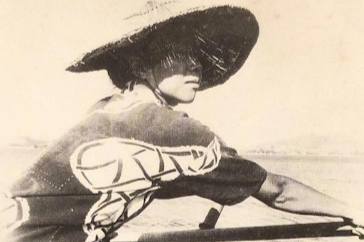
The Naked Island is an exhausting film, but also a strikingly beautiful one. It follows a small farming family living on Sukune, an isolated island off the coast of Japan. Much of the film is spent watching them retrieve fresh water from the mainland, carry it up the steep slopes and water their crops – day after day.
What makes their existence so striking is that it unfolds only minutes away from the modern Japan of the 1960s, with tourism, commerce and modern conveniences. Two radically different realities exist side by side, quietly unsettling our ideas of what modernity actually means.
The film contains almost no dialogue. It does not need it. Through repetition, movement, sound and Hikaru Hayashi’s haunting score, we begin to feel the physical rhythm of this family’s existence.
And that rhythm has not disappeared. Most of us no longer carry water up a mountainside to survive, yet work can still consume our days through repetition and necessity. The conditions have changed, but there remains something familiar in the cycle of working to sustain a life that, in turn, must be sustained so that the work can continue. In this sense, the city itself becomes almost relative. There is always another “city” somewhere else – a life that appears freer than our own.
The Naked Island is therefore both remote and uncomfortably familiar: a gorgeous aesthetic experience and a social-realist kick in the teeth.
The Naked Island is an exhausting film, but also a strikingly beautiful one. It follows a small farming family living on Sukune, an isolated island off the coast of Japan. Much of the film is spent watching them retrieve fresh water from the mainland, carry it up the steep slopes and water their crops – day after day.
What makes their existence so striking is that it unfolds only minutes away from the modern Japan of the 1960s, with tourism, commerce and modern conveniences. Two radically different realities exist side by side, quietly unsettling our ideas of what modernity actually means.
The film contains almost no dialogue. It does not need it. Through repetition, movement, sound and Hikaru Hayashi’s haunting score, we begin to feel the physical rhythm of this family’s existence.
And that rhythm has not disappeared. Most of us no longer carry water up a mountainside to survive, yet work can still consume our days through repetition and necessity. The conditions have changed, but there remains something familiar in the cycle of working to sustain a life that, in turn, must be sustained so that the work can continue. In this sense, the city itself becomes almost relative. There is always another “city” somewhere else – a life that appears freer than our own.
The Naked Island is therefore both remote and uncomfortably familiar: a gorgeous aesthetic experience and a social-realist kick in the teeth.
Vises i "Tivoli" på Det Akademiske Kvarter (Olav Kyrres Gate 49)